
-
 Infinity Media
- 6 Min Read
Biography Of Julius Malema: Net Worth, And Career Achievements
Julius Malema is one of the most talked-about political figures in modern Africa—a man whose voice has stirred crowds, challenged authority, and sparked intense debate across South Africa and beyond. Whether admired for his boldness or criticized for his controversies, Malema has carved out a space for himself as a fearless, uncompromising political force.
His story is not one of quiet rise or polished diplomacy. Instead, it is a journey fueled by raw energy, youthful rebellion, and a deep desire to reshape economic power in South Africa.
Early Life and Humble Beginnings
Julius Sello Malema was born on March 3, 1981, in Seshego, a township in Limpopo Province, South Africa. He was raised primarily by his mother, a domestic worker, and his grandmother. Life was far from easy—financial hardship was a constant reality, and like many children growing up in post-apartheid South Africa, he witnessed inequality firsthand.
From a young age, Malema showed a strong interest in politics. At just nine years old, he joined a youth structure aligned with the African National Congress (ANC), signaling the beginning of a lifelong political journey.
His early exposure to activism shaped his worldview. He wasn’t just observing politics—he was living it.
Education and Political Awakening
Malema’s education took place alongside his growing political involvement. He became active in student politics through the Congress of South African Students (COSAS), eventually rising to leadership positions.
This period was crucial. It sharpened his skills in public speaking, mobilization, and leadership. Unlike many politicians who emerge later in life, Malema’s political identity was formed early, in classrooms, rallies, and youth gatherings.
His fiery speeches and natural charisma began to draw attention, setting him apart from his peers.
Rise Through the ANC Youth League
Malema’s national breakthrough came when he rose through the ranks of the ANC Youth League (ANCYL). By 2008, he had become its president—a position that placed him at the center of South African youth politics.
As leader of the Youth League, Malema was anything but conventional. He spoke boldly about economic inequality, land redistribution, and the need for radical change. His rhetoric resonated strongly with young South Africans who felt left behind by the slow pace of transformation after apartheid.
He was also a strong supporter of Jacob Zuma during Zuma’s rise to power, a move that further boosted his visibility.
However, his outspoken nature often crossed into controversy. Statements that many considered inflammatory, along with growing tensions within the ANC, eventually led to disciplinary action.
Expulsion from the ANC
In 2012, Malema’s political journey took a dramatic turn. After a series of internal conflicts and controversial remarks, he was expelled from the ANC.
For many, this would have marked the end of a political career. For Malema, it was the beginning of something new.
Rather than retreat, he regrouped, rebranded, and prepared to challenge the system from the outside.
Founding of the Economic Freedom Fighters (EFF)
In 2013, Malema founded the Economic Freedom Fighters (EFF), a political party that would soon become one of the most influential opposition movements in South Africa.
The EFF positioned itself as a radical, leftist party focused on economic justice. Its core policies included:
-
Nationalization of mines and banks
-
Land redistribution without compensation
-
Free education and improved public services
The party’s message struck a chord with many South Africans, particularly young people and those in marginalized communities.
In the 2014 general elections, the EFF made a strong debut, securing seats in the National Assembly. Over the years, it continued to grow, maintaining a significant presence in parliament and shaping national debates.
Parliamentary Career and Political Influence
As a Member of Parliament, Malema quickly became known for his confrontational style. He challenged government officials directly, often clashing with ruling party members during parliamentary sessions.
His approach disrupted the usual tone of South African politics. He brought urgency and intensity into spaces that were often formal and restrained.
Despite criticism, his influence cannot be ignored. The EFF has consistently held a notable share of the national vote, remaining a key opposition force even as South Africa’s political landscape continues to evolve.
Malema has also shown political adaptability, indicating willingness to engage in coalition discussions when necessary, especially in a changing electoral environment.
Net Worth and Business Interests
Julius Malema’s net worth has been a subject of debate, with different estimates available. As of recent reports, his wealth is estimated to be around $15 million, though some sources suggest lower figures depending on asset valuations and disclosures.
His income and assets are believed to come from a mix of:
-
Political earnings
-
Business ventures
-
Investments in various sectors
-
Property ownership
Malema is known to own properties and luxury vehicles, which have sometimes drawn criticism, especially given his strong stance on economic equality.
This contrast between his political message and personal lifestyle has been a recurring theme in public discussions about his credibility.
Major Career Achievements
Julius Malema’s career is filled with defining moments that highlight his impact on South African politics:
1. Leadership of the ANC Youth League
He revitalized youth political engagement and brought national attention to youth issues.
2. Founding the EFF
Creating a major political party from scratch is no small feat. The EFF has become a powerful voice in South African politics.
3. Parliamentary Influence
Malema has redefined opposition politics, making it more vocal, confrontational, and youth-driven.
4. Advocacy for Economic Freedom
His persistent push for land reform and economic redistribution has kept these issues at the center of national debate.
5. Mobilizing the Youth
Few politicians have connected with young people as effectively as Malema, turning frustration into political participation.
Controversies and Legal Challenges
No biography of Julius Malema would be complete without addressing the controversies that have followed him throughout his career.
He has faced multiple legal and political challenges, including:
-
Expulsion from the ANC
-
Allegations of corruption and tax issues
-
Convictions related to hate speech
-
A court ruling finding him guilty of firearm-related offenses linked to a public incident
These events have shaped public perception of Malema as both a fearless leader and a polarizing figure.
Yet, despite these setbacks, his political relevance has remained strong. His supporters see him as a voice of truth, while critics view him as divisive.
Personal Life
Malema is married and has children, maintaining a relatively private family life despite his public persona.
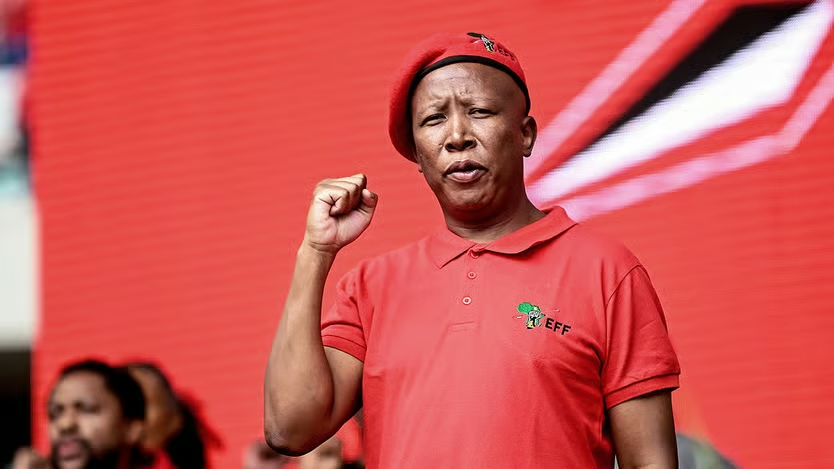
He is known for his distinctive style—often seen wearing the EFF’s signature red beret and overalls, symbolizing solidarity with workers and the poor.
Leadership Style and Ideology
Malema’s leadership style is bold, direct, and unapologetic. He speaks with conviction and rarely backs down from confrontation.
Ideologically, he positions himself as a champion of the marginalized. His political philosophy centers on economic justice, anti-capitalism, and African empowerment.
His speeches often draw on themes of historical injustice, inequality, and the need for radical transformation.
Legacy and Ongoing Influence
Julius Malema’s legacy is still unfolding, but his impact is already undeniable.
He has:
-
Shifted the tone of political discourse
-
Amplified the voices of marginalized communities
-
Forced difficult conversations about land, wealth, and inequality
Whether one agrees with him or not, Malema has ensured that economic freedom remains a central issue in South African politics.
Conclusion
The story of Julius Malema is one of resilience, controversy, and influence. From a young boy in Seshego to a national political leader, his journey reflects both the possibilities and tensions of modern South Africa.
He is not a conventional leader—and perhaps that is exactly why he continues to matter.
In a country still grappling with its past and searching for its future, Malema stands as a symbol of both disruption and determination.